How to Choose a Durable Leather Bag You’ll Actually Use
A buying guide to leather, stitching, straps, hardware and repairability—so you can judge the whole bag rather than a single marketing label.
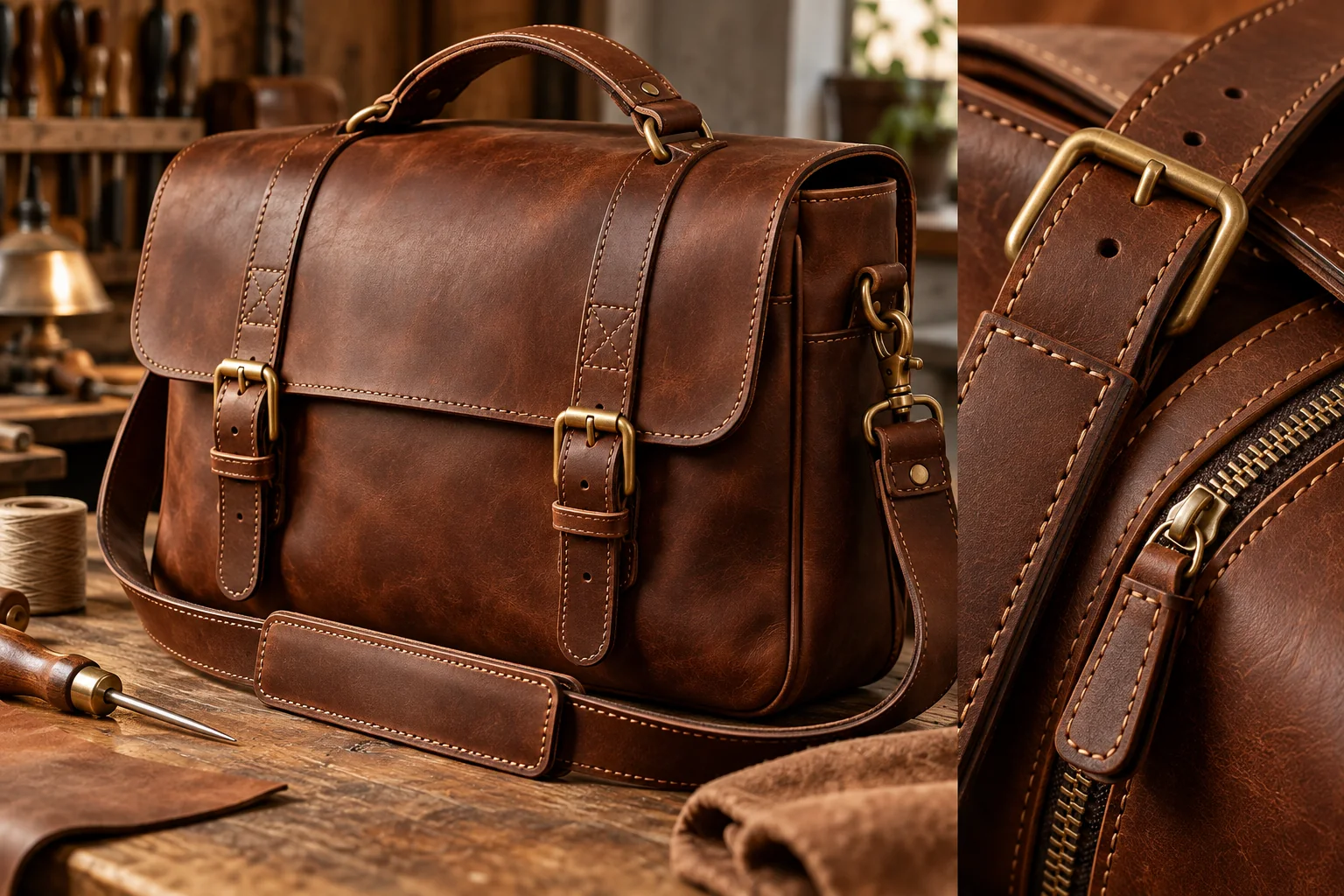
Start with the job
The most durable bag is not necessarily the heaviest one. It is the bag whose capacity, shape and carrying system suit what you will actually carry. A daily work bag may need a padded laptop compartment and a strap comfortable under load; a small crossbody needs secure closures and balanced attachment points. Think about weight, weather, commuting and how often you will set the bag on the ground before comparing leather labels.
Make a realistic packing list. Check the dimensions of a laptop, water bottle or document folder rather than relying on the bag’s name. A bag that is too small gets strained at its seams; one that is much larger than needed invites extra weight. Construction only helps if the design is appropriate for its use.
Read the leather description closely
Ask which part of the hide is used, whether the grain has been corrected and what finish is applied. Full-grain describes a grain surface that has not been mechanically corrected, but it does not by itself establish thickness, tanning method, coating, sourcing or quality control. Top-grain is used in more than one way in retail descriptions. If those details matter to you, ask the maker for a precise answer.
A smooth, coated leather may be easier to wipe clean and offer a consistent colour. A more open finish may show marks and develop a more individual surface. Suede and nubuck have a nap that usually calls for different care from smooth leather. There is no universal “best” leather: choose by feel, look, maintenance and the conditions you expect.
Ask how to care for the exact finish before buying. A manufacturer’s care guide is more useful than applying a universal cream or oil to an unknown surface. Some finishes can darken, stain or change texture when treated with an incompatible product.
Inspect the parts that carry the load
Pay close attention to handle roots, strap anchors, rivets, D-rings, zip ends and corners. These points experience repeated stress. Look for reinforcement, neat stitching and hardware that feels appropriate for the bag’s intended weight. A handsome strap is not reassuring if its attachment is narrow, poorly reinforced or difficult to repair.
Stitch count alone does not prove strength. Thread, seam allowance, stitch placement, backing material and the direction of the load all matter. If the bag is lined, ask whether the lining can be accessed for repairs. Check the base: feet or a protective panel may help on rough surfaces, but they add parts and do not make a bag indestructible.
Metal hardware should move smoothly and close securely without sharp edges that abrade the leather. Zips are a frequent repair point, so consider whether a local leather repairer can replace one. Magnetic closures are convenient but may not secure a heavily loaded bag as well as a zip or buckle. Choose a closure that suits how you travel and what you need to protect.
Repairability is a design feature
Ask the maker what can be repaired: handles, shoulder straps, lining, zip, buckle, edge paint or stitching. Is there an in-house repair service? Can a cobbler or leather worker source compatible parts? A brand with a clear repair route gives you more options if a high-wear part fails. A bag with replaceable components may be easier to maintain than one relying on glued decorative pieces.
Look for a warranty, but read what it covers and for how long. A warranty is not a prediction that nothing will go wrong, nor does a long warranty guarantee convenient repairs in every country. Ask how shipping works and whether normal wear, hardware, lining and accidental damage are included.
Compare real bags against the checklist
Vintage bags can be useful reference points for repairable construction, but age alone does not prove durability. On a pre-owned piece, inspect handle roots, seams, edge wear, lining and hardware closely; a new product page cannot tell you how a used bag has been treated.
- Frank Clegg Leatherworks — Zip-Top BriefcaseA full-leather briefcase example; check the current capacity, dimensions, leather option, weight and repair terms.
- Mulberry — Heritage BriefcaseAn example with a laptop sleeve, adjustable strap and published dimensions. Its product page identifies the leather and manufacturing location.
A practical pre-purchase checklist
Before deciding, check the bag’s finished dimensions and weight, the actual leather description, strap length and adjustability, closure, load-bearing attachment points, lining, care instructions, repair service, warranty and return policy. Read those alongside clear photos of the seams and hardware, not just a styled campaign image.
Then compare the bag to your daily routine. If you carry a heavy laptop every day, comfort and reinforcement may matter more than a delicate hand-finished surface. If the bag travels in rain, ask the maker how the leather and lining should be protected and dried. If you want a bag to age visibly, choose a finish whose changes you will enjoy. Durable buying is not about finding a perfect material; it is about choosing a well-considered object you can use, care for and repair.